We are making our latest models available for training and inference through the Pi API beta.
Deploying robots is challenging. Besides identifying the right use case and building the right hardware, developers need models intelligent enough to perform the task at hand. General-purpose robotic foundation models such as π0 and π0.5 offer a promising way to tackle this challenge. They provide a strong foundation of physical knowledge and capabilities, substantially reducing the data and effort needed to adapt to new tasks, environments, or robots. But adapting them still requires ML infrastructure, compute, and complex data pipelines, which are difficult in their own right. What if the latest and most powerful robotic foundation models could be adapted to each application through a simple and ready-made API?
The Pi API does that for you. You upload data, launch fine-tuning on compute and infrastructure we manage, and access fine-tuned models via a hosted gateway to run inference. The latest model available through the API already provides more data-efficient fine-tuning and improved capability for our partners. Since Pi can update the models underpinning the API rapidly, we plan to continue enabling access to our latest and most capable models. Launching the beta is our first step in providing the physical intelligence foundation the community can build upon and enabling end-to-end autonomy.
To ensure that the API supports diverse applications, we sought to answer two key questions. First, do our models support a broad range of applications and robotic hardware in diverse industries? Second, how easily does the API enable developers to iterate toward useful, practical autonomy?
Supporting a broad range of applications in diverse industries
To discover how broadly our models can adapt, we work closely with companies deploying robots to build autonomy systems for their applications. These collaborations let us validate how well our models perform across different tasks, hardware, and operating environments.
 ActorLocation: Utah
Actor
Actor deploys autonomous heavy machinery. Their autonomous wheel loader scoops material and loads it into a dump truck during a real commercial deployment without any operator inside the machine.
Enabling independent iteration towards practical autonomy
Across these initial collaborations, a common pattern emerged. The challenges differ from task to task: an inside-out garment, an ingredient that wouldn’t stay in a scoop, a manufacturing part that landed in the wrong position. But the process for improving performance was much the same: collect demonstrations, train a model, test it on the robot, and use the failures to decide what data to collect next. We built the API to let developers run this iteration loop themselves, using our latest models.
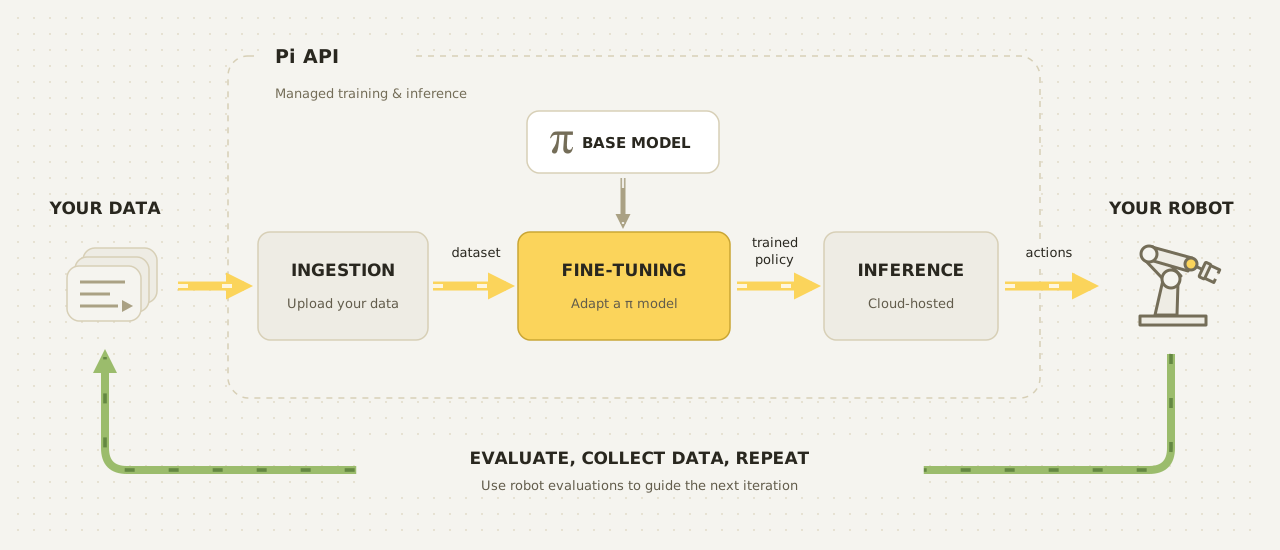
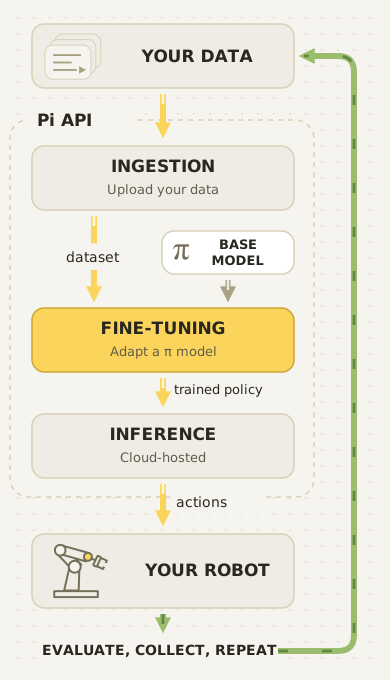
We gave a small number of companies early access to the API to test whether they could improve autonomy on their own. We were impressed by how quickly they got started and began making progress. Their experiences offer a glimpse of what you could do with your own robots and data.
 AlmondLocation: San Francisco, CA
Almond
Almond builds Axol, a dual-arm robot for physical AI builders. Their goal is for Axol to build itself. Here, Axol deburrs spacers used in its own assembly, running a model the team obtained after iterating with the Pi API for four days.
Most applications shown above, from Japan to Switzerland to deployments across the United States, ran with cloud-hosted inference through the API. These early deployments spanned a range of environments and tasks and highlighted areas for improvement, including network connectivity challenges for some.
Improving from feedback
The more our models are used, the more we learn how to improve them: by understanding the potential and limitations of our current models in real-world applications, we can make the next generation of models more broadly applicable, and make tangible progress toward truly general physical intelligence. But the range of real-world tasks is enormous, and understanding the broad range of tasks that robots could do requires making our models available for these tasks. Real-world robotic applications are not easy: tackling robotic construction, robotic surgery, or warehouse automation each requires an entire company. If each such application requires solving the physical intelligence problem from scratch, the challenges become insurmountable. By making our models available through the API, we accelerate the growth of the robotics ecosystem and, in the process, advance our own understanding of physical intelligence.
The examples above show that the models we develop can be used for real, useful applications, and that our partners are able to use the API to independently iterate on policies and improve autonomy on their tasks. We’re still early, and feedback from developers will help shape future releases.
If you would like to participate in the beta, please tell us what you want to build.
If you would like to help develop the models and tools behind this work, we’re hiring across research, infrastructure, hardware, people, and operations.